

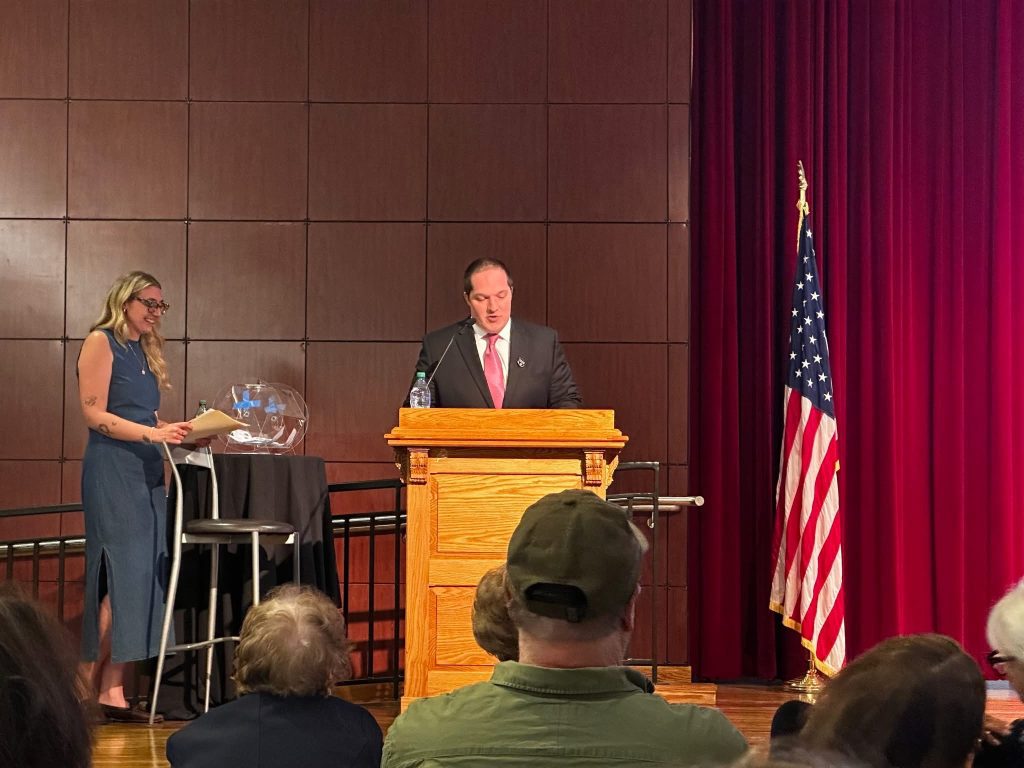
Last month, Will Kleffner, Executive Director of the Cooperstown Food Pantry (CFP), spoke at a Town Hall in Oneonta about the dire state of food insecurity in Otsego County. CFP is a member of the Alliance for a Hunger Free New York (Will is on both membership and advocacy committees), and Will is also on the Regional Food Bank’s advocacy committee.)
My name is Will Kleffner, I am the Executive Director of the Cooperstown Food Pantry. In addition to being the Executive Director of the Cooperstown Food Pantry, I am also a member of the Hunger Coalition of Otsego County, the Alliance for a Hunger Free New York, and a member of the Regional Food Bank’s advocacy committee. In my conversations with colleagues from all over the state, one common theme always seems to stand out: we are absolutely exhausted. Many of us are experiencing exponential increases in need ranging from 45-50% to as much as 200% from 2023 to 2024. Currently, the state minimum SNAP allotment is a paltry $23/month, and I recently encountered a family of four who, after waiting 30 days for their application to process, received $37/month. This is not enough to feed a family of four for a day, let alone for a month. Over the course of the last three and half years, CFP has experienced a nearly 80% increase in need, serving more seniors and multi-generational households in the last year than we have ever seen before.
Food banks and pantries often relied on USDA products, accessing necessities like fresh produce, meat, and dried beans at little to no cost. In June of 2024, the Regional Food Bank had 31 USDA products available in their warehouse, and partners could order up to 16 cases of product at a given time when available. Since June of 2024, those 31 choices have dwindled down to seven. Those seven choices are three choices of meat protein, one produce option, one grain, apple juice, and applesauce. The once abundant availability of those 31 products allowed organizations like us to purchase products such as adult and baby diapers, feminine hygiene products, and laundry detergent, as these are generally not covered by any form of federal assistance. Food banks and food pantries across the state are constantly battling insufficient resources, trying to do more with less, while also facing increased competition for local, state, and federal funds.
Federal cuts to USDA and the Local Food Procurement Act have already caused major interruptions in our food supply chain, forcing organizations who are already stretched incredibly thin, to pivot and find new resources. As of March 2025, under the most recent USDA cuts, the Regional Food Bank had one million pounds of contracted food deliveries canceled. To put that into better perspective, that is equivalent to about 35 tractor trailers carrying 24-28,000 pounds of food. No food drive can fill a gap this substantial.
We must ask ourselves about the impact of these cuts. Food banks and food pantries will have to find alternative sources for food, likely paying full retail value or more, potentially requiring feeding programs to restructure funding to prioritize sourcing much-needed products. At the Cooperstown Food Pantry, this could mean losing our Farmers’ Market Voucher Program in partnership with Otsego 2000, providing our neighbors in need with $20 worth of free vouchers for fresh fruits and vegetables at the Cooperstown Farmers’ Market each month. This program has proven not only to increase our neighbors’ access to fresh fruits and vegetables but contributes to the local economy.
In 2024, there was a 75.9% increase from $13,000 in 2023 to nearly $23,000 in local food items provided to our neighbors in need. So far in 2025, $11,000 in local food was provided through the Market’s food access initiatives. Along with providing local food to people in need, these programs bring more business to local farmers and the local economy. It is estimated that every $1 in SNAP generates $1.80 in economic impact. Meaning in 2024, SNAP at our Farmers’ Market generated more than $40,000 in local economic activity.
Congressman [Josh] Riley has made it abundantly clear that he is deeply opposed to any cuts to safety net programs like SNAP and Medicaid and recognizes and understands the challenges many of us face in providing support to our neighbors in rural communities. The proposed “big, beautiful bill” has the potential to increase need by 100% in Otsego County. We anticipate about half of our smaller, local pantries closing in the process. Under this bill, SNAP cost-shifts would require New York State to find $1.8 billion to fund this program alone, very likely eliminating focus on programs like the Universal Free School Meals Program that provide free breakfast and lunch to nearly 3 million students in the state of NY.
Any cuts to Medicaid would further strain local hospitals and would very likely leave the nearly 13,300 people currently enrolled in Medicaid in Otsego County without health coverage. At CFP, we firmly believe that no one should ever have to choose between paying for the cost of treatment and paying for the cost of food. Participants in Food as Medicine Programs would no longer have to make the impossible choice between paying for food or treatment, as they simply will not be able to afford either.
What is truly upsetting is that we have seen the positive impacts that investments in our safety net programs have on those living in poverty. In 2021, primarily due to the temporary expansions of the Child Tax Credit under the American Rescue Plan, we saw Childhood Poverty levels reach a historic low of 5.2%. When those expansions expired in 2022, this resulted in growth of childhood poverty rates to nearly 19% in New York State. Under the SNAP Emergency Allotments where minimums started at $95 per month, we saw historic lows in demand at the Cooperstown Food Pantry. Following the elimination of the Emergency Allotments in 2023 with an average cut of $90 per month per household, food pantries and food banks have once again begun to see increases in demand as high as 200%.
Instead of building on the success of these investments and initiatives, we are headed in the opposite direction, making cuts to current programs and stymying future programs that will affect as much as 20% of the population of Otsego County who rely on them for survival.
While we may be tired, we simply cannot give up. We cannot lose hope. We must continue to fight alongside Congressman Riley to oppose these cruel, draconian cuts, not only to protect the most vulnerable members of our Otsego County communities, but for all New Yorkers.
You can support the Cooperstown Food Pantry’s efforts by donating directly to their fund at CFOC